Go to content
Fellowships

In Conversation with the NFF Fellows: Nirit Peled

Every year, three artists work on their own innovative research at the intersection of technology and society in the NFF Fellowships Programme. In this special programme, everything is up for discussion: the questions being asked, the methods used, even the outcomes are not fixed. To give insight into their work forms, dilemmas, and motivations, Paulien Dresscher, curator of the programme and researcher in the field of digital culture, engages in conversation with the Fellows.

The third Fellow this year is Nirit Peled.

Fellows 2025-2026
Part 3:  Nirit Peled

Green Clouds

Green Clouds: On Remembering and Forgetting

Nirit Peled is researching remembering and forgetting in the digital age.

Never before could we preserve so much of our lives. Photos, messages, documents, search histories and other digital traces are stored almost automatically, often without us consciously deciding what to keep and what to let go. With ease, we carry more than twenty thousand photos with us all day long, and many times that number sit in the cloud. This near-limitless ability to capture and preserve raises questions. What does preserving do to our memory, and to our society? And what are the planetary costs of all that storage, now that we're covering ever larger parts of the Earth with data centres — data centres that, moreover, consume enormous quantities of water, a resource that's growing scarcer even in the Netherlands?

As a maker, Nirit Peled is hard to pin down. She originally trained as an artist and designer, but gradually became more and more involved in storytelling in other forms too. As a journalist, documentary maker and writer, she worked for Tegenlicht and wrote pieces for De Groene Amsterdammer. In doing so, she's continued to develop new methods for describing, and reflecting on, the world around her. Yet the core of her work remains the research itself — the asking of questions.

For me, this fellowship was about allowing myself to stay with the question. Not to search for answers right away, to keep looking critically, to stay curious. And then to take a step beyond journalism, and arrive at art, to discover how you actually tell the story.”
--Nirit Peled

The starting point for Peled's research project Green Clouds is the realisation that storage is never neutral. In her previous performance, Off the Record, Peled examined an algorithm used by the police to assess risk and predict which young people might end up in crime. She realised that storing the personal data of young repeat offenders had a huge impact on the rest of their lives: “It basically means that when we look at their file, we see a kind of concentration of all the bad things they've done.” There's no nuance, none of the good things in their lives are recorded, and — perhaps most importantly — it continues to haunt them endlessly. She offers her own life as a counter-example: “I could have been that kid. I've done plenty of bad things too, but my data isn't available to you, is it?” The underlying question here, of course, is to what extent you can capture a human life in data. And to what extent this encourages a society not only to never forget, but also to never forgive. Preserving and retaining also have a darker side.

From Evidence to Feeling

Peled is fascinated by investigative journalism, but found that some stories call for a different register than journalism alone can offer. Yet she doesn't see her return to the arts as an escape from journalism, but rather as a complement to it. “I don't think journalists should start writing science fiction,” she says, “but I do think some of those stories should spill over into the arts, because the artist can do something different.” The arts have the capacity to make the experience and impact of something intangible — an algorithm, a data centre, loss — palpable through imagination and speculation, without the burden of proof that journalism carries.

That shift from evidence to experience becomes clear in her description of data centres, seen from an aeroplane window: “It looks like a Lego landscape of infrastructure. And all of this infrastructure is designed to preserve you.” It's a line that connects two things: the documentary and the personal.

Green Clouds 3

The Waiting Room

The most personal element of Green Clouds — and at the same time the element she wrestles with most — is her own illness. “During the year I started researching, just before the fellowship began, I got sick, and my world changed,” she says. From a hospital room, surrounded by invasive treatment and with all the time in the world, she was at the mercy of her phone to pass the hours. She recalls how, while she was ill, the public debate around artificial intelligence was picking up steam, with the promise that it could cure disease: “The greenwashing of AI was: what if we could cure cancer?” But out of that hope grew an uncomfortable question too: what are we willing to sacrifice for technology that promises to keep us alive longer?

The seemingly strange comparison — that technology can cure cancer but can also save your photos — becomes a little less absurd once you realise both impulses stem from the same refusal to accept decay.

I think that in our solutionist, media-optimistic mindset, there's very little room for decay, forgetting and dying. As if technology could free us from all that. But do we really want to live forever, and remember everything?”
--Nirit Peled

In her research, Peled looked at various forms of digital legacy offered to terminally ill patients — ways of leaving something of yourself behind that, set against the reality of death, seem to promise a kind of immortality.

She describes how cancer patients in hospital are offered the chance to record themselves in a nicely produced short interview or video, for those left behind. You can even train a bot on yourself, so that your children can still talk to their parent after you're gone. Pursuing this form of digital immortality can, in Peled's eyes, be seen as the most extreme edge of a culture that would rather resolve illness and mortality than live through them.

From the Body to the Earth

What connects the waiting room to her broader research into data centres and ecology is a simple question she asked herself: “What happens if curing myself has an impact on the liveability of the Earth? What if we can cure people, but pollute the oceans and our planet at the same time?”

Green Clouds 2

We extract minerals from the ground to store data; solar panels fill the North Holland landscape: as we preserve data, Peled argues, we create a kind of ecological forgetfulness: “You create a scar somewhere else, you extract minerals, you destroy one thing because you want to preserve another. We make our cities green, and then everything around us turns to wasteland. Is this what we want?”

Even so, for Peled, her work isn't an indictment of technology itself, and she's explicit about her own entanglement with it. “I also just want to play with AI. I find it fascinating.” But that's precisely why she also feels a responsibility to ask where it's heading: “We're the generation that still knew the world without the internet and AI — we witnessed the transition, and helped drive it forward. That gives us a responsibility to document its impact.” She backs this up with her own memory of the internet's arrival: “The internet came with such an enormous promise of freedom. We couldn't believe there was anything bad about it” — a blindness she doesn't want to repeat now, with AI.

What Isn't Documented

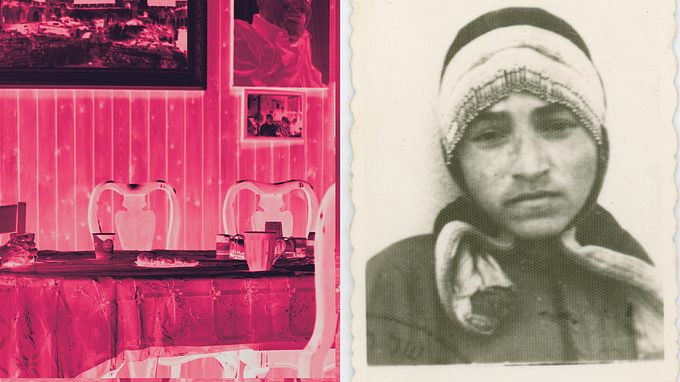
In the lecture performance she's developing within the Fellowship, she sets this abundance of digital storage against another kind of memory: the oral tradition of her own family, Yemenite Jews who migrated to Israel. Her grandmother, affectionately nicknamed “the pirate” by her grandchildren for her headscarf, died before Nirit could ask her the questions she now, too late, wishes she had. “It's funny — while she was still here, I never asked her anything.” What strikes her is how many people recognise this: almost no one records the memories of loved ones while they're still alive, despite all the technology now available for exactly that.

The absence of documentation, she reflects, also holds a paradoxical power. On the fate of the Yemenite community, she says: “Terrible things happened to the Jews who left Yemen, but it isn't documented. It's not something they can look back at, so it becomes a story, an oral history — they find a place for it.” Against that, she poses a pointed question, aimed at future generations who will be fully documented: “What happens when everything is documented, and we have to live, all the time, with the burden of proof?” Forgetting, here, doesn't simply mean leaving something behind or moving on. It's also about the possibility of carrying the past in other ways — of passing it on, and finding it a place.

Staying With the Question

If there's one thing that recurs as a method throughout the whole conversation, it's her refusal to draw conclusions. “Stay with the question,” she says more than once, almost as a motto.

You don't have to make statements. You have to ask the question. Take the time to form an opinion.”
--Nirit Peled

For Peled, that's not an absence of position, but a method of inquiry. She's interested in how different ways of looking — journalistic, cinematic, algorithmic — determine what we can know and see, but also who or what stays out of frame.

With Green Clouds, Peled discovered the essay as both a form of research and a form of storytelling. A form in which she can draw connections between the personal and the technological, between the body and infrastructure, the Earth and, ultimately, even orbital space. It's precisely the speculative that gives her room to lay these different layers alongside one another, and to imagine the future.

I have to observe,” she says of her way of working. “A dialogue has to begin between me and something. There has to be a story.” The project that emerged from the waiting room — that journey, “from the deeply personal to the cosmological” — is, in the end, nothing other than that question, sustained through all its layers: what does it mean to preserve something, and what does it cost to never forget?

Written by Paulien Dresscher 

back to