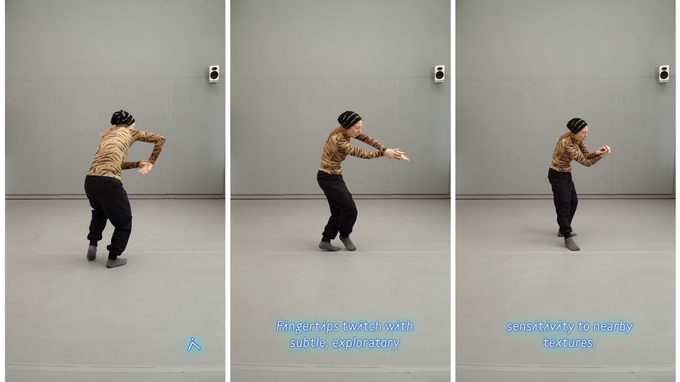
An important part of Maurer's process is the sense that something new is emerging: that she and the AI are developing something together, and that a certain direction is being taken. But that's not always straightforward: “I keep asking myself: which direction do I actually want to go in? Lately, relational prompts have turned out to be the most interesting. Those are prompts that revolve around the relationship between me and the model. Dancing with a ball, for instance, the model might be asked to talk back from the perspective of that ball.”
The form of the AI's memory also plays a role. In the tech world, a model with memory is generally seen as a strength. In Maurer's model, the AI remembers nothing from previous conversations: each session starts fresh, meaning every new prompt can shape an entirely new world.
Friction
For Maurer, DOOP ultimately isn't just about AI, but above all about what happens in the space between human and machine. Friction plays a central role in this, taking on different forms throughout her dance research: physical, relational, and translational.
First, there's physical friction. By using her whole body and moving in ways that are experimental, unfamiliar, awkward or even uncomfortable, resistance arises at a bodily level. It's precisely there that Maurer finds a direct reward: the body is pulled out of fixed patterns, and the act of moving itself brings pleasure.
Then there's relational friction. When the installation works well, a complex relationship forms between dancer and machine. The AI voice suggests, asks, encourages and comments while Maurer dances. She allows herself to be challenged and disrupted by that voice; sometimes she resists its suggestions, sometimes they inspire her. The interaction can be playful and enjoyable, but also strange, absurd or irritating. It's precisely that shifting experience that pushes her deeper into her body: to act, play, experiment and respond.
The third form is friction in translation. In conversation with philosopher Miriam Rasch — author of the book Frictie: ethiek in tijden van dataïsme (Friction: Ethics in an Age of Dataism) and one of the coaches on this trajectory — it became clear to Maurer just how essential translation is. According to Rasch, data and figures are always already a translation of a messy reality that has been cleaned up and simplified. And yet we often act as though we know exactly what that data means, even though everyone can read something different into it. Friction arises precisely by allowing those differing interpretations to exist, rather than smoothing over ambiguity.
In DOOP, that translational friction is magnified. The machine translates Maurer's movements into a prompt, but that translation is never pure: it's noisy, ambiguous, fallible. Maurer then interprets that prompt not literally, but subjectively and intuitively, after which the machine responds again in turn. This creates an ongoing feedback loop — a great noise machine — in which every step is a choice among countless possible directions.